Sustainable development
Origins of the principle
Stockholm
Some say it can be traced to Stockholm.
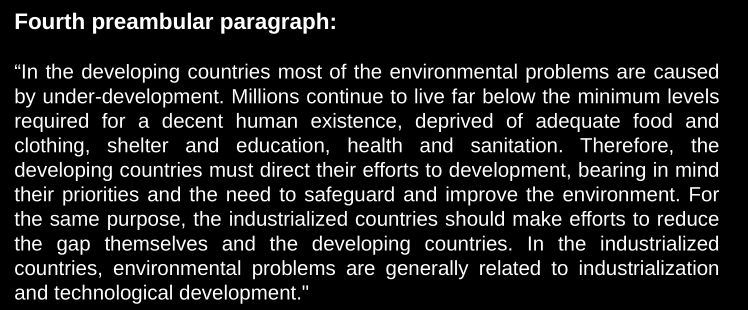
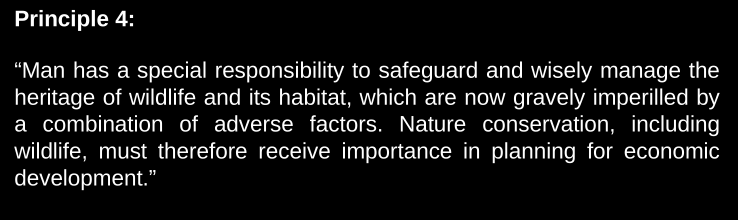 It is the origin of IEL but not of SD, no mention at all. We can see it was based on an imbalance between environmental protection and economic development. F.ex. principle 4 which says that nature conservation must receive importance but isn’t talking about balancing.
Resolution 35/36
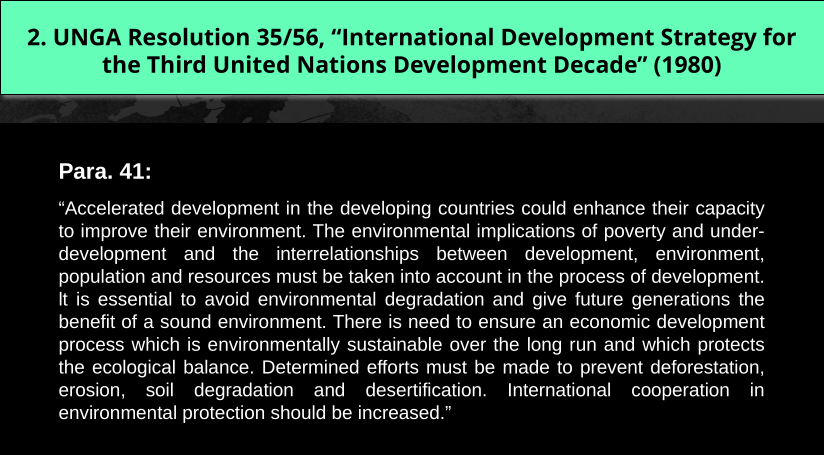 It does reference environmentally sustainable, so this concept was narratively present in 1980 but it doesn’t aim at saying sustainable development but the need to ensure an economic development process which is or should be environmentally sustainable. It doesn’t talk about sustainable development.
Environmental protection is considered in isolation from development. It isn’t integrated like with sustainable development. The adjective sustainable is mentioned, that’s all it is… a prior reference to the idea of sustainability.
No consensus though.
Brundtland Report
Actual origin as we saw Session 4-Rio and.
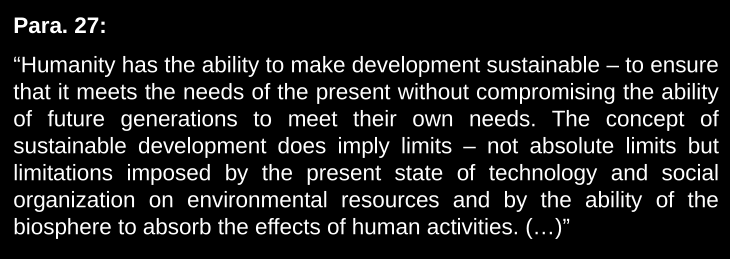 Moment when the idea of sustainable development became part of the narrative of IEL and confirmed in Rio 1992. Integration of sustainability and development.
Meaning
This concept or notion hasn’t been legally systematised, in soft or hard law. What is the actual meaning?
Rio
Doesn’t contain an homogeneous definition despite officialising it.
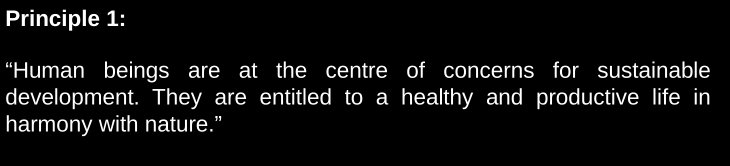 The very first principle codifies a right explaining that they are at the centre of concerns for SD and doesn’t even define it. It does let us extrapolate that it has the fulfilment of this right birthed from anthropocentric approaches as its goal. Comes from Stockholm.
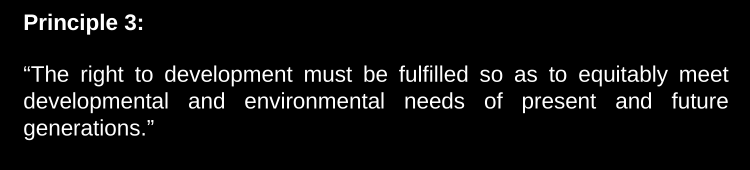 When it comes to the right to development, it has to be achieved respecting intergenerational equity. This is a definition of sustainable development. It’s also kind of what the BR did.
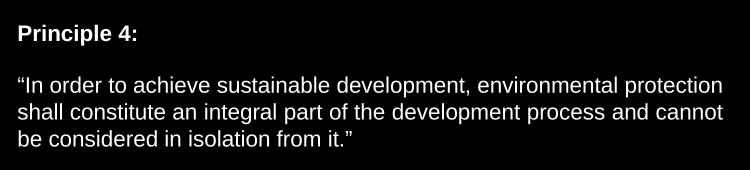 Then in P4 we see the integrative approach. Sustainable development is achieved when environmental protection is integral to developing and cannot be considered in isolation to it. This is the big contribution of Rio to sustainable development, the added value on what it is truly. It shows what the meaning should truly be.
But
This doesn’t solve the issue, Rio kind of obscures the meaning even more. They forgot social development. It was only in Rio +10 that this changes, as in Rio it is just expanded even more without clarity.
Rio +10 and the Johannesburg Declaration on Sustainable Development (2002)
The Johannesburg Summit on Sustainable Development, 10 years after Rio the international community corrects the mistake of the Rio declaration legally.
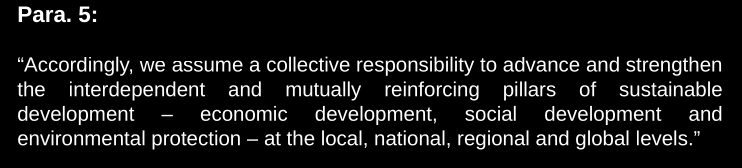 Interdependent and mutually reinforcing pillars of sustainable development, economic development, social development and environmental protection. Because in Rio the social development pillar of sustainable development was forgotten. It’s not only about 2 reinforcing and interdependent pillars but 3.
After 2002, as before, the meaning stayed blurred and kept being confusing for the international community.
Rio +20
The future we want: UNGA Resolution 66/288. Made the meaning more inconsistent.
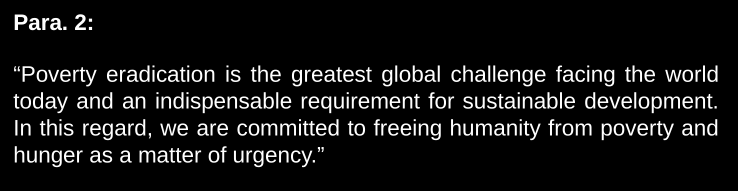 Sustainable development became about poverty eradication as well.
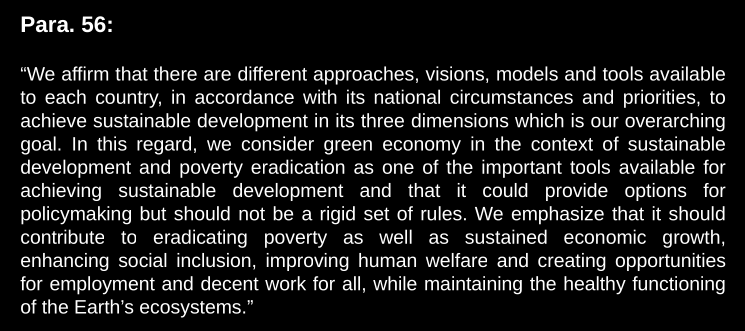 Sustainable development is about green economy… but here we say there are different tools, approches, etc… according with circumstances and priorities nationally to achieve sustainable development. It was kinda given up on. It became a self-judging concept.
UNGA Resolution 70/1
Transforming our World: the 2030 Agenda for Sustainable Development. Basically the agenda for SD until 2030. It’s all about SDGs. It’s very multifaceted, SDGs mean everything and nothing.
So far we have looked at how soft law didn’t help with the definition at all. But treaty law isn’t very helpful either, multilateral environmental agreements don’t define it better.
Kyoto Protocol to the United Nations Framework Convention on Climate Change (1997)
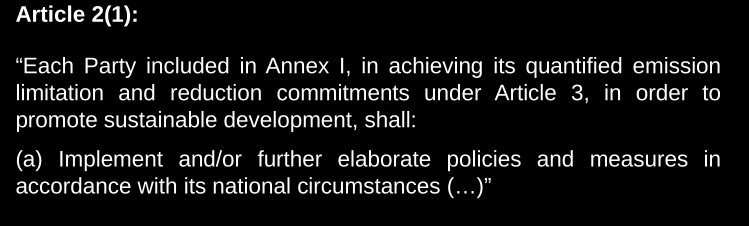 Here it’s the same thing as in the future we want.
United Nations Framework Convention on Climate Change (1992)
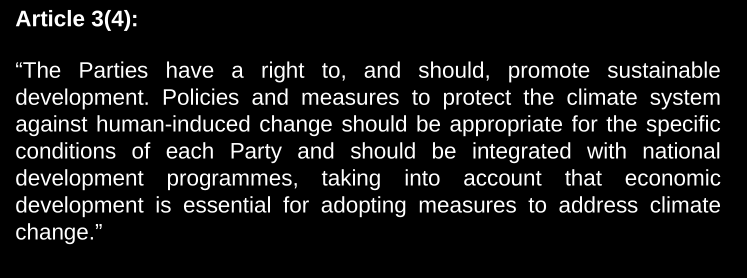 Same issue as with The future we want.
Convention on Biological Diversity (1992)
Rio sister convention, there were 3 on them→this one + UN framework convention on climate change and the UN convention on desertification. They were up for signing in the Rio Conference.
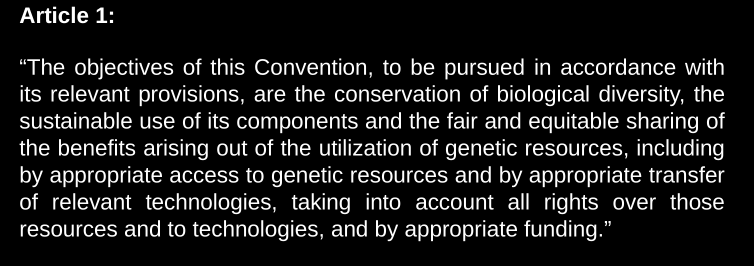 In other treaties it’s not even called sustainable development but something else. Now it’s about sustainable use… but is it the same? It’s the same language.
United Nations Convention to Combat Desertification (1994)
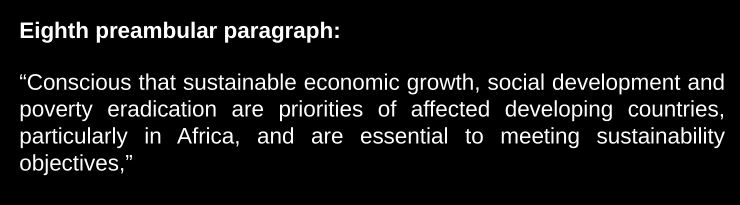 Here it’s sustainability, now we can’t even use the same designation. Does sustainability mean sustainable development? Now we say poverty eradication…
Antigua Convention (2002)

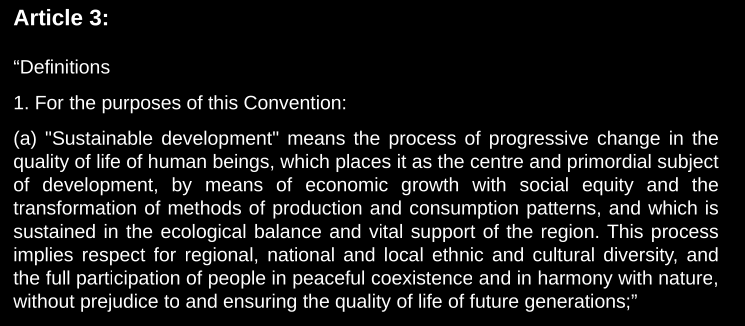 It says only for the purpose of the convention, they kind of assume it’s not defined. States want predictability that IEL doesn’t grant. Here it kind of means everything. It even includes cultural diversity…
So is SD law? Is it defined? What is the legal status? Does it create obligations? Is it a principle then? Sometimes not even clear.
Gabčíkovo-Nagymaros Project (Hungary/Slovakia) (1997)
The Danube dispute between HG and SK. They had put a project for joint investment in hydroelectric production, basically a system of damns to increase production of energy. Slovakia did it, as it became the successor state of its father state. But Hungary never did so, it postponed because of economic issues and by the 1990s there was the fall of the Berlin Wall and Hungarian scientists attacked it as anti-ecological and being able to destroy the ecosystems of the Danube.
So the Hungarian government terminated it unilaterally. Slovakia was so upset it made another damn to deprive Hungary from more of 80% of the water. This almost led to war but the European Commission conducted mediation so as to set the dispute peacefully at the ICJ.
Hungary explained it wasn’t a developmental project as it harmed the environment and Slovakia said it was in its right to develop for more hydroelectric energy. It is the first sustainable dispute ever really. The court felt it was important to send a strong message to the international community therefore.
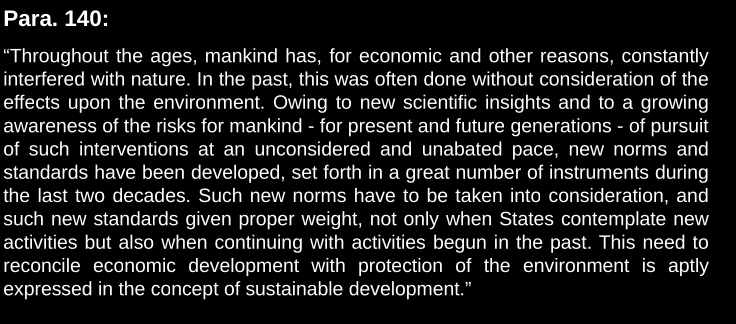 Recognises intergenerational equity and the efforts in the last 2 decades to develop new norms and standards. It makes it clear that a new era has started, where there is a need to reconcile, not confront or clash, economic development with environmental protection. The court qualifies it without hesitance, but doesn’t say what its legal character is, only that it is a concept (names it sustainable development so references it). And it admits it is also applicable to past activities. It gives it retroactive effect. Quite the paradox.
Award in the Arbitration regarding the Iron Rhine (2005)
8 years after, it being a concept was contested.
When Belgium and the Netherlands confirmed their separation they decided they could build a railway to allow transport of goods between them until the Rhine sector of the Netherlands. But after the 2WW it was no longer used, so natural reserves were created by the Netherlands in the area of the Iron Rhine.
Based on the 1839 treaty Belgium said in 2005 they wanted reactivation, and Netherlands said they now had natural reserves. They submitted it to arbitration.
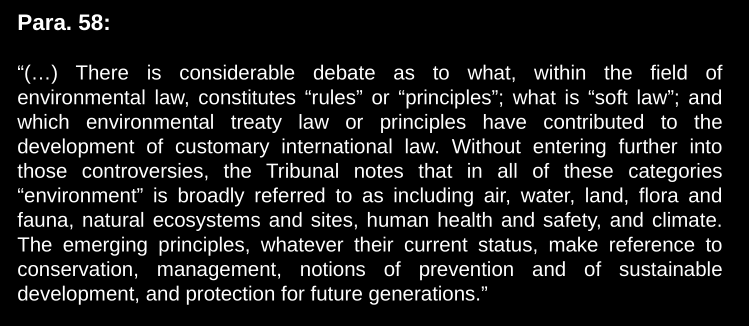 The award admits lack of consensus: what are laws, principles, what treaties have contributed to customary law…? But it stays outside the controversies. It does say there are emerging principles. It doesn’t get legalistic though. Among those emerging principles, it identifies 1.
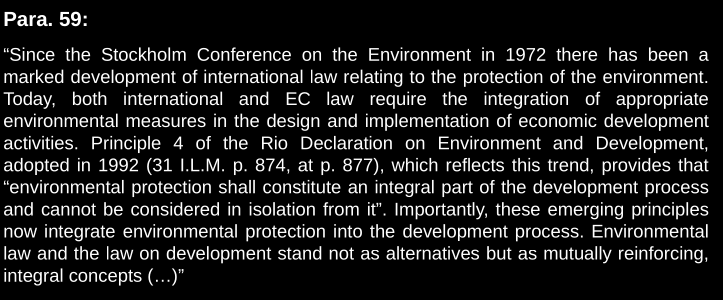 It says since Stockholm there has been marked development. So today international law requires to integrate economic development with environmental measures. This is customary international law language. No matter the status of the emerging principle this means it has customary law effects. Case law therefore says clearly it is about integration. Development and environment law are not alternatives but mutually reinforcing and integral concepts. Clear as day.
Pulp Mills on the River Uruguay (Argentina v. Uruguay)
5 years later in 2010 courts had to get around sustainable development again, they said it’s an objective. Progress but not a principle.
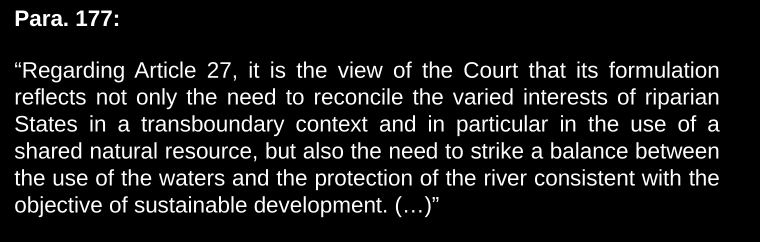
 Again: integration, balance, etc… They all opt for P4→integration.
Obligations of States in Respect of Climate Change, Advisory Opinion (ICJ, 2025)
Finally they say it’s a principle, at the end of the award:
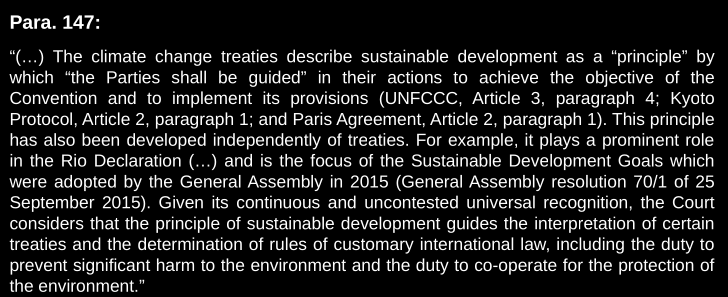 More than 30 years after Rio. Weirdly it’s a principle but guides only interpretation for certain treaties… contradictory. Even when they admit it’s a principle it is subject to uncertainty. Explains why certain tribunals are hesitant to give it broad power, when the definition is still unsure. The legal status of this principle is a gap according to the contemporaneous UNSG (Guterres), may be better to live it like that so it is dynamic and evolves to the needs of the international community as well as it’s interests.