The Birth of Sustainable Development
Rio Conference on Environment and Development
Organised to officialise the sustainable development agenda, thus the name. Quite the semantic shift, it is specifically on environment and development. The first time ever that IEL contemplated the marriage between environment and development, both on an equal footing→symbiotic relationship/balance/equilibrium however you wanna call it. This whereas Stockholm and WCN where based on imbalance.
Importance
It is the most known and authoritative, till this day, declaration on the environment. Just saying declaration of Rio is enough. We are now in the era of Rio +30. It is most of IEL, most of the treaties after Rio are just implementing or operationalising principles contained in Rio. This, as it is a declaration of principles containing the fundamental principles of IEL since 92 and thus a soft law instrument.
And Stockholm?
Not irrelevant in some of its principles, e.g. codification of no-harm, however non-invocable in isolation of Rio. It has to be read in its light as the latter marks a legal step forward in comparison.
Rio Declaration
Principle 1
 Again right to a healthy environment like with Stockholm, anthropocentrism isn’t gone. Now the language is more precise and legalistic (entitlement to a right) though. Also not a weird mix of strange rights.
Indeed some of the principles of Stockholm were reiterated later in Rio, we can’t forget either of them.
Principle 2
 Principle of intergenerational equity. Generations unborn/to come, deserve to have their needs preserved. Since 1992 this is part of the fundamental principles of IEL, the corpus juri. Environmental protection, nationally and internationally, requires to take into account intergenerational equity→the needs of those to come. Either way not doing it is a violation. However, implementing it at the domestic level is not that simple. Who should speak on behalf of future generations in our countries? Who has this legal standing?
This depends on the legal system. Asia is the most progressive region on this (India, Philippines). The Minor Oposa case against the governor of the Philippines is very famous. Young children of the Oposa family filed a case against him as he was enacting policies destroying the rainforests. In that new world of intergenerational equity as guiding principle of state action on the environment the supreme court said it was a duty for present generations to represent future generations.
Principle 3
Intragenerational equity, so within the same generation. Novelty of IEL, before Rio - like with Stockholm - there wasn’t really such a principle. But with sustainable development came this principle. IEL has become all about this type of development, where the main idea is how to reduce the gap between the rich and the poor.
Protecting the environment is expensive and it is thus important to think about mechanisms and principles so that developing states can protect the environment without being subject to further economic constraints or poverty in their development efforts. That’s what this principle is about.
We don’t want countries in the present to allocate resources only to the environment because this could make them poorer and hinder development (education, health, infrastructure, etc.) we don’t want to make more constraints.
Principle 5
 Political facet of intragenerational equity. The idea here is to eradicate poverty, decrease disparities in standards of living. How do we do this while protecting the environment though? This is central in IEL though, constantly mentioned as it was here from its youth.
Developing states constantly say they cannot adopt environmental policies that will make them poor. This is unethical but legal, we need laws that states can rely on. Intragenerational equity.
Principle 6
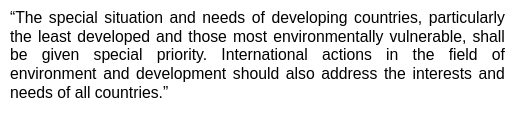 Similar principle. The vulnerable, developing, etc… states need special and differentiated treatment in IEL. Acting for the environment also has to take their intragenerational equity, their needs and interests are important. They need financial mechanisms.
Saying I won’t work for the environment until I get my financial mechanisms isn’t blackmail, but using the law. The economical facet of intragenerational equity.
Principle 7
The legal facets, subjecting developing states to less IEL constraints.
G77
The developing countries (pro-China) came at the beginning of Rio with this Principle 7:
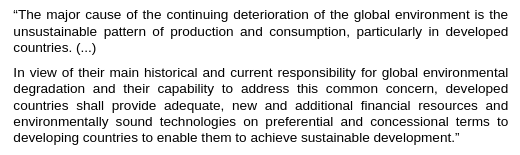 Basically putting the responsibility (all of it) on rich countries for the degradation of the environment. Rich countries, specially the USA, said this would never make it into Rio and that they would sabotage the conference if this was included.
They made this in the end:
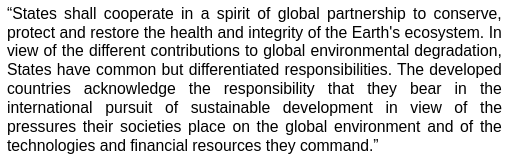 A new principle of IEL law in the name of intragenerational equity→CBDR (particularly implemented nowadays in the fight towards global warming).
Some say that colonialism caused damage environmentally and now requires compensation, or that certain countries didn’t partake in damage and now are among the most vulnerable. This isn’t only literature but advocacy. Teach says debt cancellation is a fair and equitable way to make reparations. This isn’t what we see here though.
It does recognise differences in contribution to damage although without accusatory language.
USA reaction
The USA although didn’t like it:
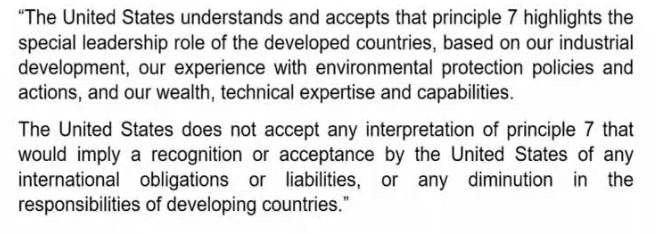 Kind of spun it around as being better and thus deserving leadership and not as an international obligation/liability or diminution in the responsibilities of developing countries. Basically for them CBDR isn’t a principle→tensions to this day in stuff like the COP between developed countries and developing ones.
Principle 10
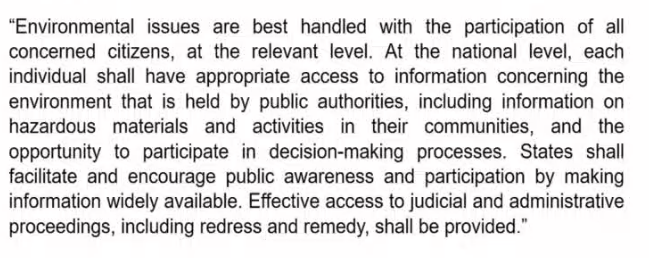 Environmental democracy, a new principle of IEL. Environmental protection can’t be limited to states like with Stockholm which was very state-centred. Basically other actors should have a say in environmental protection. 3 pillars:
- Public participation in environmental decision-making.
- Access to environmental information.
- For the people/citizens to participate, they need to be informed on environmental risks f.ex.
- Access to environmental justice.
- They should be able to complain before impartial remedies.
Implementation
The most advanced region is Europe, since 1997 there is the AARRHUS Convention on public participation, access to information and access to justice in environmental matters. In CH f.ex. you can complain about violations but there is no such convention elsewhere, except in South America and the Caribbean where there is one since ~2018 (ESCAZU Convention).
So in a big part of the world there is no implementation of this principle. And in fact, most human rights violations happen (assassinations, etc.) because of people raising their voices against governmental projects that could harm the environment. Environmental democracy isn’t well protected.
Principle 12
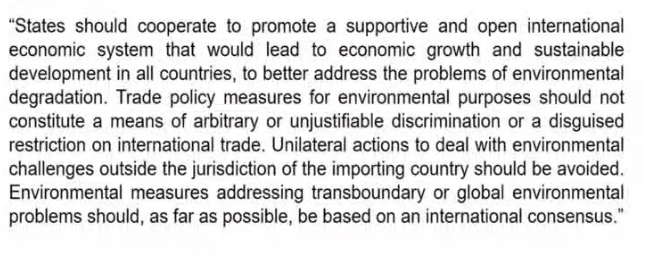 Since Stockholm, declaration of principles constantly reiterate cooperation as a principle of IEL→also visible in Rio. Not cooperating in good faith is a violation, many states thus violate IEL principles. Unilateral actions are illegal.
E.g.: Tariffs on countries that do not enact policies to fight global warming without first negotiating with them like the EU does is plainly illegal. You can’t go for unilateralism without trying cooperation first. And some countries have CBDRs…
Prevention
The Rio declaration has led to the sophistication of prevention, whereas in Stockholm it was limited to the no harm principle.
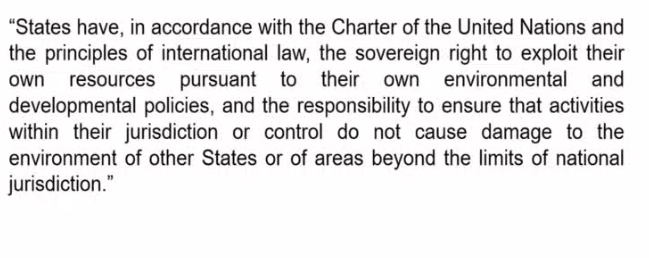 In Rio we still have no harm (Principle 2), but with 2 other pillars.
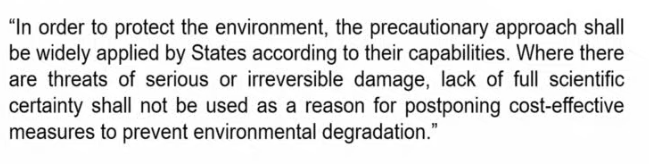 Precaution in principle 15, so as to act even in the case of scientific uncertainty.
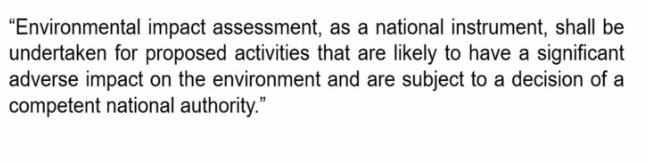 Proceduralisation of prevention in principle 17, so as to conduct an environmental impact assessment as a national instrument (EIA).
Principle 16
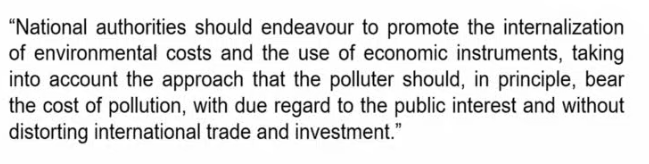 Polluter pays principle, not about prevention but reaction. If you pollute (commit harm to the environment), you need to pay for the harm you committed. The idea is to internalise environmental costs so that the polluter, rather than society or the state, bears the financial burden of pollution, often through economic instruments such as taxes, charges, or liability mechanisms without fucking up trade/investment.