Initial Approaches to the Protection of the Environment at the International Level
Before 1972, even if in an utilitarian way, it was courts rather than states who contributed to the filling of gaps in the to-be IEL. Additionally, we could see no inclusion of the environment in IL in our last session (Session 2, 3-Emergence internationally). This is also true for the UN Charter. But as we saw, some factors made it so that an environmental agenda for the UN was pushed. This caused several actions.
Stockholm conference
First ever international/UN conference on the environment. Not only the environment, but the human environment.
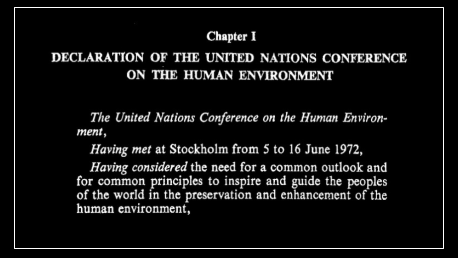 This means that when we started cooperating at the international community level we did it in an anthropocentric way. We didn’t want to protect it by itself, for itself. The utilitarian heritage continued. Regardless, this was the birth of IEL.
Perspectives
It is possible to criticise it though, some scholars that follow third world approaches to environmental protection do. These even say that in 1968 the African community had already adopted a convention on the conservation of nature. It is to this day the only comprehensive text on this topic. We can say that this was a pioneer moment but it was only a regional text, and here we are speaking about an universal birth of IEL. It depends on the perspective, but it’d be Stockholm rather than the Alger conference.
Stockholm declaration
After the conference, the very first declaration of principles for IEL was created:
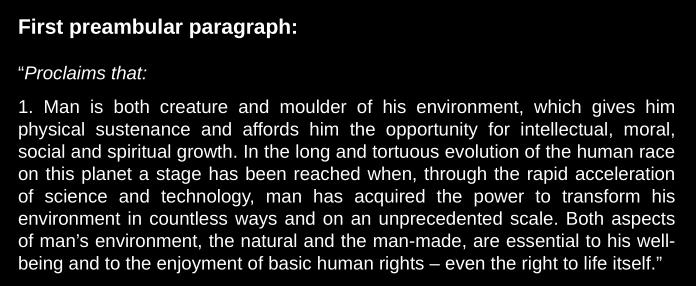 It was only a soft law instrument, however it started everything. Here the idea wasn’t to constrain but to guide without imposing any rules. This is clear in the preamble seen above.
It is important, because it represents a strong consensus of the international community when it comes to protecting the environment and the principles that should guide such action. States are often more willing to follow soft law instruments than a treaty.
It explains that man is a moulder but also a creature of the environment, it needs it. It gives man social, moral and spiritual development which explains the need to protect it.
First principle
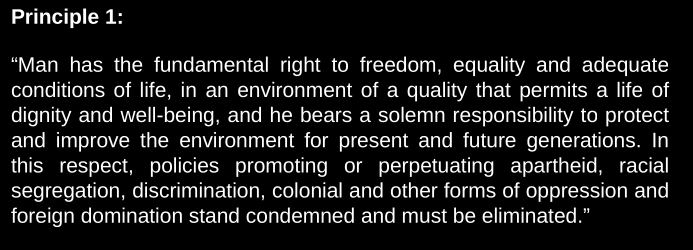 Human right to an adequate environment. So anthropocentric that a new human right was created. In 1972 a right to a healthy environment was nonexistent (e.g. EDHR). This principle however mixes many things but specifies little. It mixes environment with colonialism, racism, etc…
This is a sign of the way states go step by step in the formulation of IEL. They agree there is a right to a healthy environment but don’t impose anything else, they just connect it to preexisting stuff.
Third principle
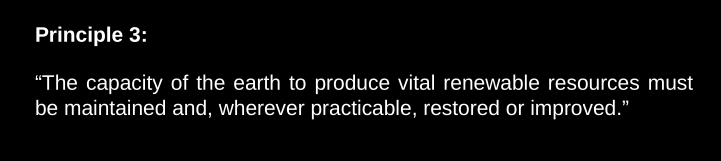 We now know, contrary to what we though then, most resources are exhaustible (clean air, water, etc…). We were convinced the earth was capable to regenerate the resources we so much needed. We supposedly had the ability to improve or restore its capacity to do so.
Fifth principle
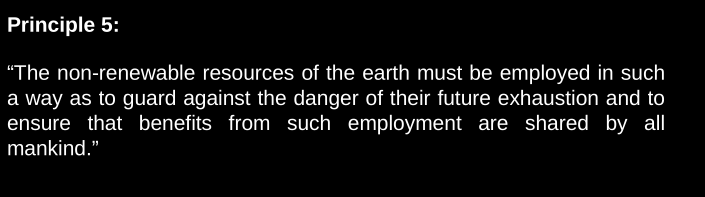 Again, utilitarist.
Eighteenth principle
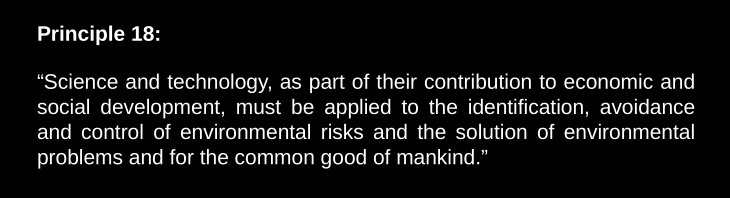 It was believed science could anticipate, identify, control, avoid any environmental phenomenon or complexity. This anthropocentric vision was wrong. Same thing as with no harm, it must be known that harm is coming. Same logic here, too much faith in science. This is why things have gone wrong, we though states had no duty to act if we didn’t know.
Fourth principle
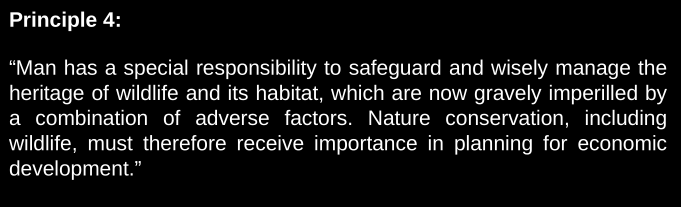 The primacy of economic development over environmental protection. Sustainable development, contrary to what some claim, wasn’t born with this declaration. This would mean balance between economy and environment, which there isn’t. No consensus was reached on this.
A lot of developing countries were very suspicious of the environmental agenda, they thought it was made to slow down the economic development process of their community. This came at a time when African countries were fighting for the new international economic order. This was done to convince them that this wasn’t an attempt of putting more conditions on top of their development efforts.
Eight principle
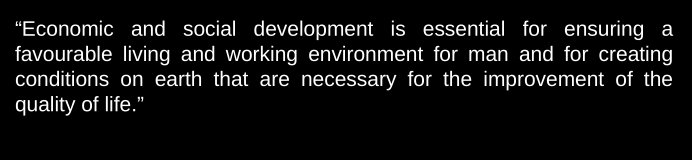 Same, preserving but for development→utilitarily.
Eleventh principle
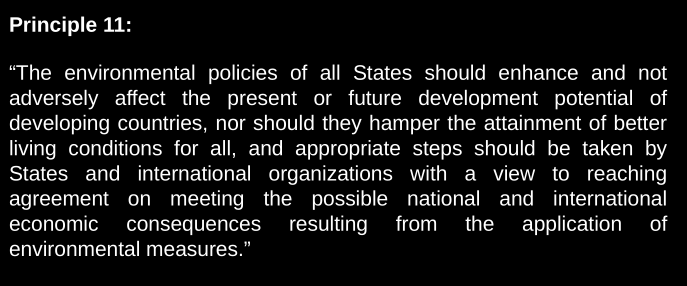 Same reasoning as preceding principle. Indeed, e.g. the World Bank never paid any attention to the environment in its development projects like when giving money to build damns.
Twentyfirst principle
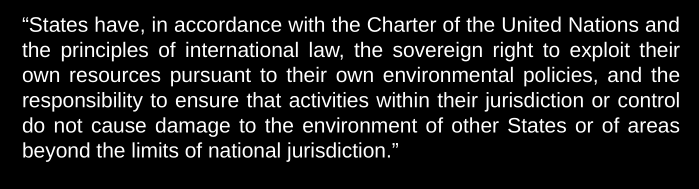 Represents/Codifies the principle of no-harm which was already customary law. This might be soft law but this part of its content is very much binding. There are changes:
- Here it is missing the application conditions established by serious injury and clear and convincing evidence (state has to know it).
- The environment is also named, which wasn’t the case before.
- Even the areas beyond national jurisdiction are included (non-state areas).
- The Moon, the deep seabed, etc…
Twentyfourth principle
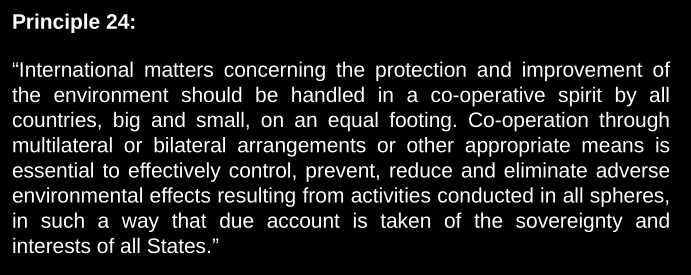 Principle of cooperation. They say it should be a principle→should, as they didn’t want binding language (it is soft law after all).
After Stockholm, the WCN
Reagan opposed a summit from the UN (Stockholm +10 in 1982) that was supposed to happen. This didn’t prevent the UNGA to actually write a resolution:
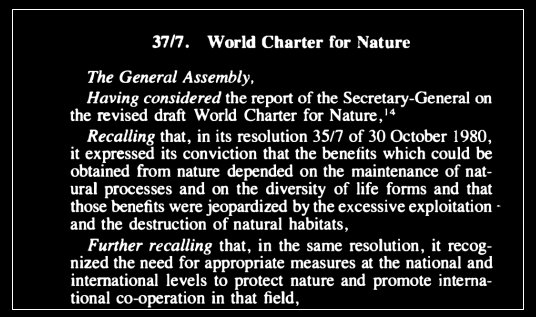 This represented a shift in the evolution of IEL, the WCfN adopted what can be called an ecocentric/systemic approach to environmental protection. This meant that environmental protection was now the priority compared to economic development, inverting the relation codified in Stockholm. The first time this was done, which explains the importance of this text.
The semantic text can be seen in the title… human environment (STCK)→nature (WCN).
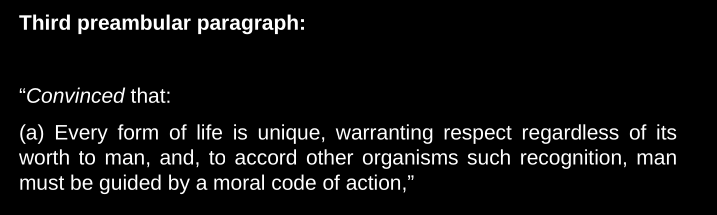 And regardless of its worth to man, no utilitarism.
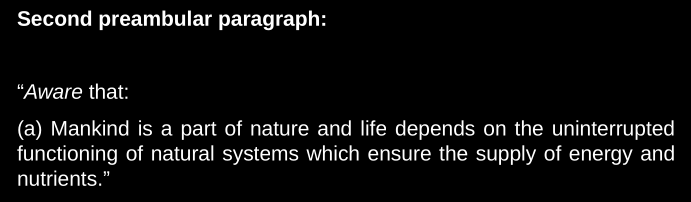 Here we reverse the arrogance of Stockholm→we are part of nature and depend on it. When there is consensus, change can happen. Most of the international community voted for the WCN.
Hélas
Despite all these important steps the state of the environment worsened and worsened, IEL failed in protecting the environment. The 1990s was probably the worst decade in terms of environmental disasters: The Bopal disaster with the pesticide plant in India, desertification in Africa, Tchernobyl, the Basel accident, etc…
In 1987 we had a new idea→sustainable development. There was a severe need for a new agenda and action for the environment internationally.