Poverty
MDGs and SDGs
MDG Goal 1: Eradicate extreme poverty and hunger.
- Target 1.A: Halve, between 1990 and 2015, the proportion of people whose income is less than one dollar a day.
- Indicator 1.1—Proportion of population living below $1.25 (PPP) a day.
- Inconsistency? Not really.
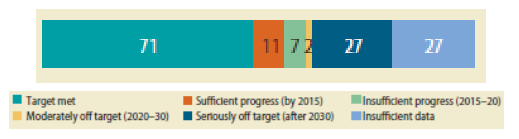
- Inconsistency? Not really.
SDG 1. End poverty in all its forms everywhere.
- 1.1 By 2030, eradicate extreme poverty for all people everywhere, currently measured as people living on less than $1.25 a day.
- 1.2 By 2030, reduce at least by half the proportion of men, women and children of all ages living in poverty in all its dimensions according to national definitions.
- Not only income.
Evolution of people living in poverty (income)
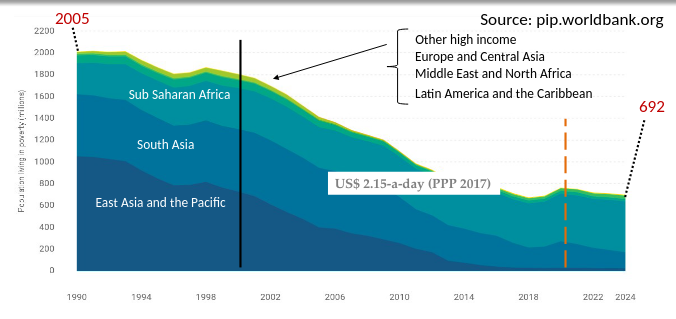 Substantial reductions in poverty in East Asia and the Pacific and South Asia (rapid growth and development of China and India has helped lift millions of people out of poverty). PPP as computed in 2021 is indicated, not done in an annual basis as it requires purchasing power index for many countries. In 2026, the reference is 2021 and the threshold (ITS 3$ PER DAY, TYPO) used is from last year.
Everytime PPP changes we recompute.
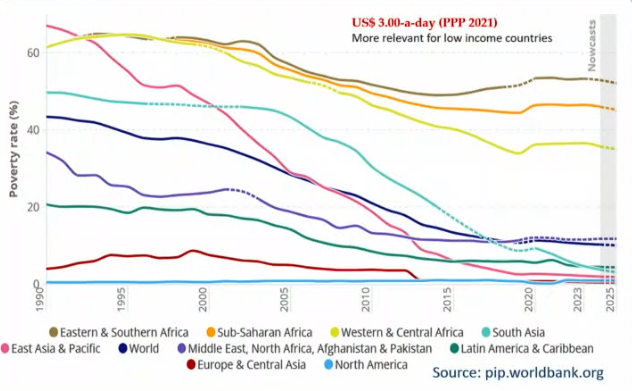 More poor individuals in Africa.
Different thresholds
Depending on what threshold you take things can change a lot. The higher the threshold the more poor people appear on the graph. Why have different ones? They are calculated using data from different countries, e.g. 3$xday is more relevant for low-income countries as they were used to calculate this threshold. This allows to consistently identify poverty in certain types of countries. We can’t apply anything to anyone.
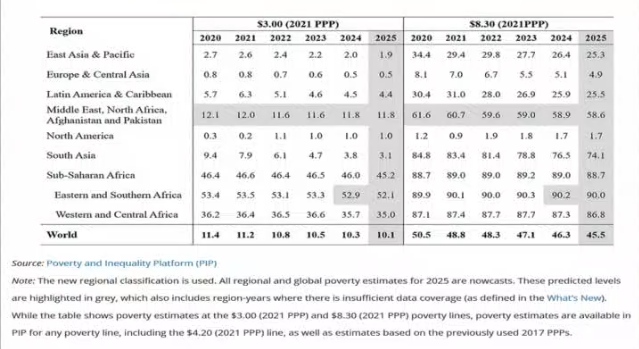 Here we can see the differences between thresholds. Using the wrong one, as we can see, can lead us to extrapolate false conclusions.
Covid impact
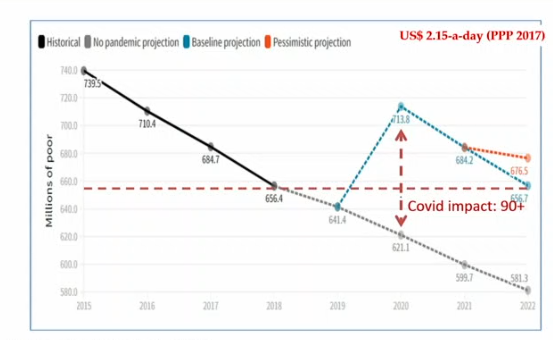 The poverty line changed relative to it’s expected trajectory. If we had no additional global shocks (in this case climate change) the recovery would have been even better (blue line). Either way it’s a projection from 2021/2.
Measurement
Poverty lines
- Individuals/households are poor when their expenditure (or income) falls below a poverty line.
- Poverty lines can be based on three methods: the cost of basic needs, food energy intake, and subjective evaluations.
- While the first two methods best apply to absolute poverty lines, the last method best applies to relative poverty lines.
Cost of basic needs
- Most commonly used is the cost of basic needs approach.
- It first estimates the cost of acquiring enough food for adequate nutrition – usually 2,100 Calories per person per day – and then adds on the cost of other essentials such as clothing and shelter.
- The method proceeds as follows: a) stipulate a consumption bundle that is deemed to be adequate, with both food and non-food components; and b)estimate the cost of the bundle for each subgroup (urban/rural, each region, etc.).
- The basic needs approach requires information on the prices of the goods that the poor consume.
- When price information is lacking, which might be the case in rural areas, one may use the food energy intake method, which graphs expenditure (or income) per capita against food consumption (in Calories per person per day).
- From this, one may determine the expenditure (or income) level at which a household acquires enough food.
Subjective method
- Subjective poverty lines are based on asking people what minimum income level is needed in order to just make ends meet.
- More about perception, not observation of the interviewer.
- These approaches are complementary.
Absolute lines
- An absolute poverty line is useful in tracking the evolution of poverty over time and is also useful when evaluating the effects of policies and programs on the incidence of poverty.
- Poverty lines can be revised from time to time: intertemporal comparison is only possible if the same poverty line is used to compute poverty rates in different years.
- There are national and international poverty lines.
- International poverty lines (the World Bank) are based on national ones.
- These have their limitations because the definitions might not be the same across countries, but these are useful for stuff like SDGs when we wanna monitor evolution of poverty globally.