Economic Analysis in International Organisations
What is the economic rationale of having International Organisations?
- The economic rationale can be found in the reasons for government intervention in the economy if we think of IOs as supranational governments (not necessarily true if no legally binding decisions can be taken).
There are 5 major reasons for government intervention in the market
- Provide information and assure information flows (reduce asymmetric information).
- Economically it is more efficient, which we want, when everyone is provided the same maximum information.
- Address externalities (i.e external costs and benefits).
- We know what it is from Séance19,20-Les externalités.
- Provide public goods (non-excludable and non-rivalrous).
- Not profitable for private entities, government has to be the one to do it therefore (with the money raised through various means).
- Not clear how it could be made profitable for private entities, that’s where this consensus on responsibility comes from.
- Not profitable for private entities, government has to be the one to do it therefore (with the money raised through various means).
- Control noncompetitive behaviour.
- Monopolies f.ex., which can appear naturally in some cases and are fought against by government.
- E.g. trains, where it’s difficult to see various competing entities. So the government takes care of the infrastructure which reduces entry costs so they can compete (e.g. French vs. Italian trains to go to France).
- F.ex. impede the merging of certain firms which could become too big and assert too much dominance over the industries such as the car one, creating rising prices for consumers.
- Monopolies f.ex., which can appear naturally in some cases and are fought against by government.
- Change income distribution.
- Redistribute income to reduce inequality, as it is associated with a decrease in welfare. Only a central power can do this.
Justifying these reasons
- The first four reasons may be justified because they promote Pareto optimality (efficiency).
- What is a Pareto optimal resource allocation? (Efficiency versus equity: Welfare economics theorems).
- The fifth reason may be justified if society desires to guide the economy to a particular Pareto-optimal resource allocation, for example, one that is more equitable.
- Pareto doesn’t always mean ethic or equitable.
- Concepts can vary between societies.
- Pareto doesn’t always mean ethic or equitable.
As perfectly-competitive markets can be considered theoretical and non-realistic we need a central authority to maintain them in an ethical and equitable manner.
Governments’ Policies to Disseminate Information
- Education / Technical cooperation.
- Public supported media and information delivery.
- Collection and distribution of price and other economic and social data.
- Some governments don’t have national statistic institutes or do not connect certain types of data, so IOs also partake in this.
- Labelling requirements.
- E.g ISO.
These policies exist at the national level as well as the international one.
Externalities
Externalities exist when the activities of one or more agents affect the preferences or technologies of other agents.
- Negative (Positive) externalities: reduce (increase) utility or productivity of other agents.
- Production Externalities: occur when the productivity of an individual is affected by activities of others.
- Consumption Externalities: occur when the welfare of some individuals is affected by the consumption activities of other individuals.
Public goods
They re characterised by two features:
- Non-rivalry: can be consumed concurrently by more than one individual.
- Non-excludability: can be accessed freely.
Examples of Public Goods
- Knowledge from education and public research.
- National Security.
- International Trade Agreements.
- Infrastructure, such as roads, bridges, etc.
- If it becomes international, IOs can intervene f.ex.
- Environmental Amenities, such as clean air
Non-competitive behaviour
So far only national or regional bodies exist (e.g. EU Directorate General for Competition DGIV) despite the growing market power of multinational firms and in particular technological ones (e.g. the US Magnificent Seven or Chinese BAXT).
Transfer Policies
Policies designed to change the distribution and/or wealth in society. These are also used in the international system, between countries.
- Examples of transfer policies at the national level: Income taxes, Inheritance taxes, Social Security, Tax breaks of various kinds to corporations, Subsidised loans for home buying.
- Examples of transfer policies at the international level: Official development assistance, Special and differential treatment (special rights given to developing countries).
What do IOs do?
Promoting Global Peace and Security
International organisations like the United Nations (UN) work to prevent conflicts, mediate disputes, and maintain international peace through diplomacy, peacekeeping missions, and conflict resolution mechanisms.
- Is the situation complicated at the UNSC level (vetoes, etc…)? Yes, but it mustn’t be mistaken with the Secretariat’s work.
Facilitating International Cooperation
IOs provide a platform for countries to collaborate on shared issues, such as climate change, terrorism, and pandemics, which transcend national borders and require collective action.
- Must be ratified and negotiated by countries obviously.
Providing Humanitarian Assistance
IOs (e.g. Red Cross and UN agencies) deliver aid and support during crises, such as natural disasters, wars, and famines, ensuring relief reaches those in need.
Fostering Cultural and Scientific Exchange
Organisations like UNESCO promote cultural understanding, education, and scientific collaboration, enriching global knowledge and fostering mutual respect among nations.
MDGs and SDGs
MDGs
- The Millennium Declaration, adopted by the United Nations General Assembly in September 2000, was a landmark agreement in which 189 member states committed to addressing global challenges such as poverty, hunger, disease, and environmental degradation.
- Kind of setting a negotiation platform/base.
- The declaration laid the foundation for the Millennium Development Goals (MDGs), a set of eight goals aimed at improving human well-being by 2015.
- The internationally agreed framework of 8 goals and 18 targets was complemented by 48 technical indicators to measure progress towards the Millennium Development Goals.
- The MDGs were revolutionary in providing a common language to reach global agreement.
- Substantial progress has been made regarding the MDGs: the first MDG (target 1A) of halving the World extreme poverty rate by 2015 has been realised (A China and India effect).
- However, the achievements have been uneven across goals and across countries.
SDGs
- The MDGs were set to expire in 2015 and the discussion of a post-2015 development agenda started in 2012 led to the adoption by the UN General Assembly of the Sustainable Development Goals in September 2015.
- There was a feeling of some being unachieved and there was a sequel of some sort.
- There has been discussion, this framework might not be the most socioeconomically efficient way of doing it. It is more of a political outcome, we have to distinguish from the Secretariat.
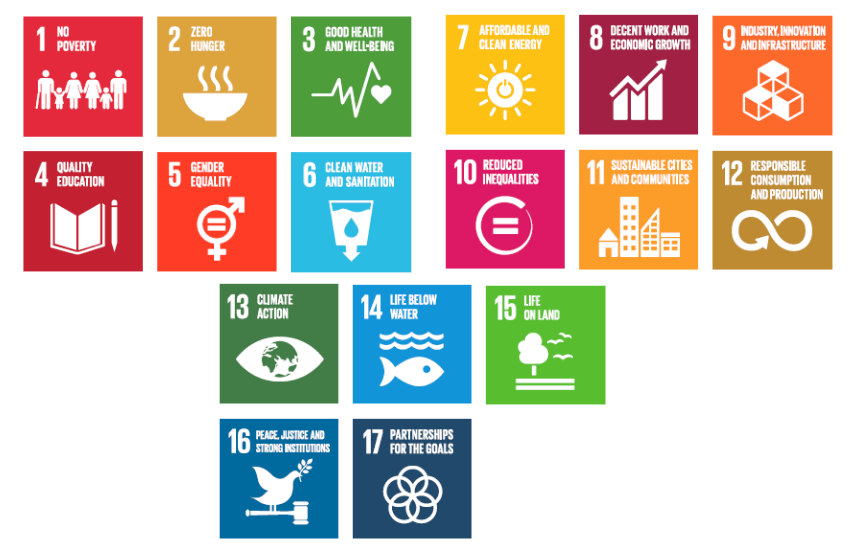
- The Official Agenda for Sustainable Development (Transforming our world: the 2030 Agenda for Sustainable Development) adopted on 25 September 2015 outlined (paragraph 51) the 17 Sustainable Development Goals for leaving no one behind and its associated 169 targets completed by 231 unique technical indicators.
- SDGs’ focus : building a sustainable world where environmental sustainability, social inclusion, and economic development are equally valued.
- Various parts of sustainability.
- Equitable societies are good for growth and prosperity; Protecting the environment is necessary to ensure more inclusive and sustainable livelihoods; The economic engines of prosperity can and must benefit society at large as well as the planet.
- In 2030 it ends, maybe there’ll be a successor talked about soon as with the MDGs we started in 2012.
Renewal
- The Sustainable Development Goals and targets have come into effect on 1 January 2016 and (should) guide decisions member States take up to 2030.
- Reviewing its progress is crucial as it will ensure it remains relevant and ambitious.
- The review is annual and centralised through the High-level Political Forum: next session in July 2026 (https://hlpf.un.org/2026).
- The theme of the 2026 HLPF will be Transformative, equitable, innovative and coordinated actions for the 2030 Agenda and its SDGs for a sustainable future for all. The Goals to undergo in-depth review are: Goals 6 (Clean Water and Sanitation), 7 (Affordable and Clean Energy), 9 (Industry Innovation and Infrastructure), 11 (Sustainable Cities and Communities) , and 17 (Partnerships for the Goals).
- So as to see where to direct funding, which projects according to the necessities posed by these goals and their objectives. F.ex. climate change where we are more in the mitigation phase than in the adaptation one.